
Italian Renaissance Masterpiece goes on view at the National Gallery in London
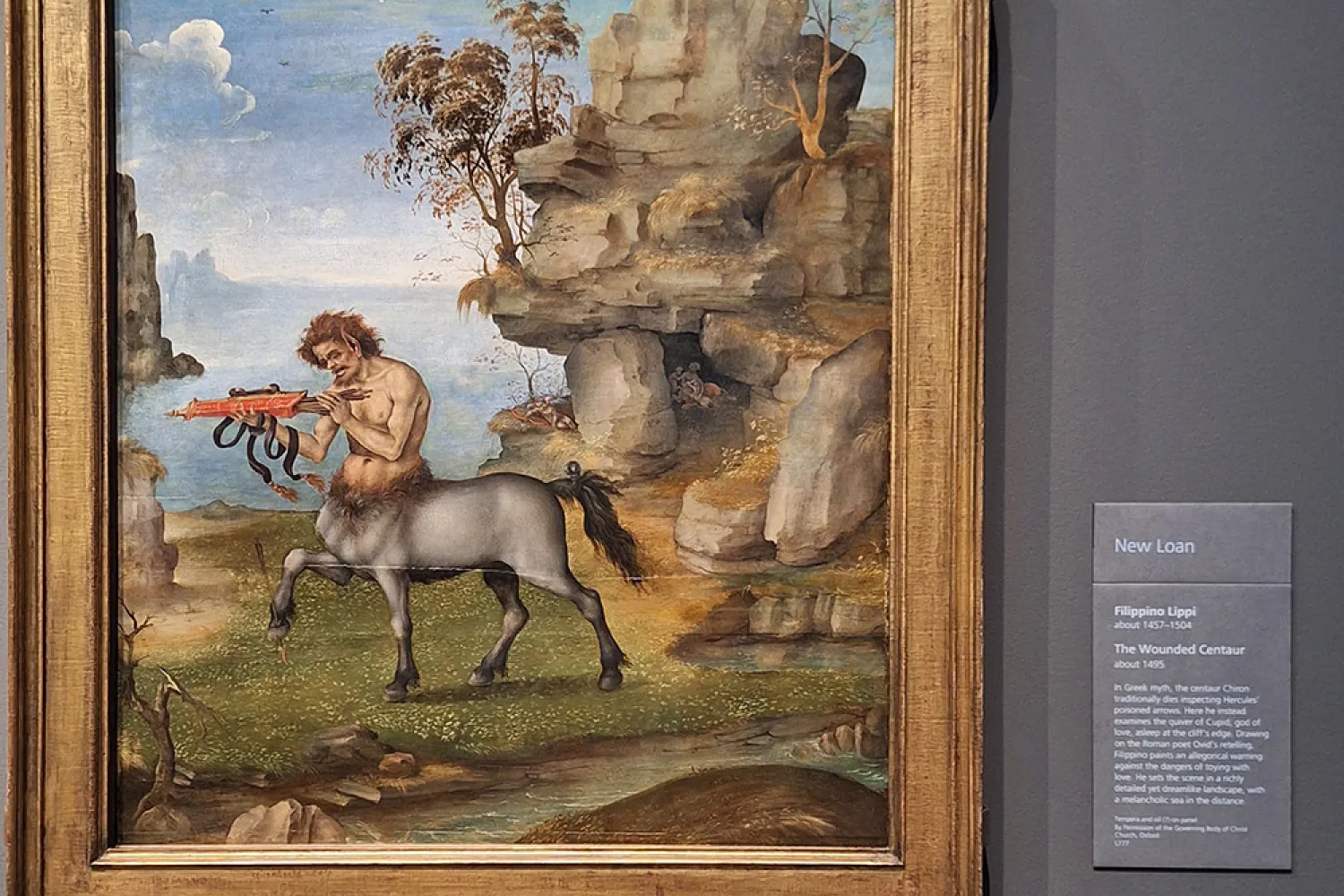
An Italian Renaissance Masterpiece – The Wounded Centaur – by the Florentine artist Filippino Lippi (c. 1457-1504) is now on view at the National Gallery in London (Room 62 in the Sainsbury Wing) while its permanent home, Christ Church Picture Gallery in Oxford, undergoes a major refurbishment.
One of Christ Church Picture Gallery’s most significant paintings, Filippino Lippi’s The Wounded Centaur, is now on display at the National Gallery in London for the duration of the Picture Gallery’s major refurbishment.
The Wounded Centaur was painted towards the end of the fifteenth century (c. 1495) by the Florentine artist Filippino Lippi. It is among the most intriguing mythological paintings of the Italian Renaissance and is an early example in which the surrounding landscape is given equal importance to the mythological characters populating it. Jacqueline Thalmann, Curator of the Picture Gallery, explains more.
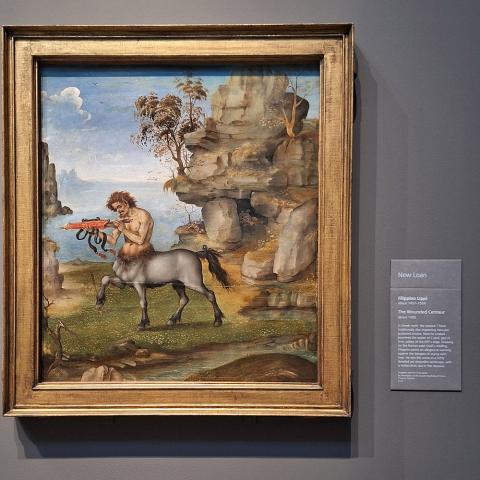
A centaur (half man, half horse) stands in an open landscape examining a delicately-embellished orange quiver and the arrows it contains. His raised hoof has been pierced by one of the arrows and we seem to witness the moment when the pain of the injury sinks in, while a stream quietly flows in the foreground and the mist rises around a rock formation in the background. Protected, in the shadow of a cave, lies a female centaur nurturing two young, while Cupid, the god of love, reclines on a grassy bank holding an orange-coloured bow.
What makes this painting so fascinating and intellectually playful – and the masterpiece it is – is not just its elegance and novel subject matter, but the ambiguity of the scene. Filippino depicts the moment of stillness directly after an incident, but before the realisation of what actually happened. The viewers will need to construct their own story and interpretation. Did the Centaur injure himself or was the arrow released by Cupid? Does the broken branch in the foreground hint at a struggle? Is the Centaur’s family aware of the events outside their cave? And how does a centaurial family fit in the story at all? Cupid, the wounded Centaur (might it be Chiron, who injured himself with the poisoned arrows of Hercules?) are known from other tales, but Filippino invents something new and previously unseen. The image was designed to create debate among its viewers, a feat that was regarded as one of the highest forms of artistic genius in Florence at the time.
Filippino Lippi was one of the leading artists of his generation combining intellectual inventiveness with stylistic elegance and beauty. He was trained by his father, Fra Filippo Lippi, at the same time as Sandro Botticelli, whose workshop he joined after his father’s death and before becoming his own master.
The Wounded Centaur was gifted to Christ Church in 1828 by the diplomat, botanist and collector William Thomas Horner Fox-Strangways (later 4th Earl of Ilchester) (1795-1865) who bought it during his time as Secretary to the Legation in Florence (1825-28). Since its arrival in Oxford it has been displayed to the public at Christ Church.
Due to its fragility it hardly ever left Oxford, but the fame of the painting drew a steady stream of art pilgrims to the Picture Gallery. It is therefore with great pleasure that we can announce that the Wounded Centaur will remain on view in London at the National Gallery, while Christ Church Picture Gallery undergoes a major refurbishment.
The National Gallery draws millions of visitors from around the world and remains free of charge. This means that many more people will get acquainted with one of Filippino’s mythological masterpieces and those who already know it well can just drop in at Trafalgar Square to see an old friend.
For now the painting is on show in room 62 in the National Gallery’s Sainsbury Wing among other giants of the Florentine Renaissance, Alessandro Botticelli’s Mars and Venus, Paolo Uccello’s Battle of San Romano and Piero di Cosimo’s Death of a Nymph.
Christ Church is deeply grateful to the National Gallery and all the individuals at Trafalgar Square, who helped to make this possible.
Further plans to expand on this project and several other curatorial exchanges and collaborations have been drawn up and are being explored and we look forward to sharing more over the next months and years, while the Picture Gallery will be fully refurbished and prepared for their return.
Read about the plans for a major renovation and extension of the Christ Church Picture Gallery, transforming the Grade II listed building into an expanded, world-class facility designed to preserve and enhance public and scholarly access to one of the world’s finest ‘small’ Old Master collections.
Other Christ Church news