Established in 2017, the Research Centre aims to assist senior members of Christ Church in their pursuit of advanced research and scholarship in their field of expertise.

Above all, the Centre aims to support those projects which undertake to explore the potential development of new ideas, often in an interdisciplinary fashion, including speculative, sometimes even high-risk work. It aims furthermore to assist early career scholars in establishing themselves in their field of research, as well as those senior scholars with a heavy teaching and/or administrative burden. Funding includes research assistance costs, travel to meet with colleagues, visiting archives, organizing symposia.

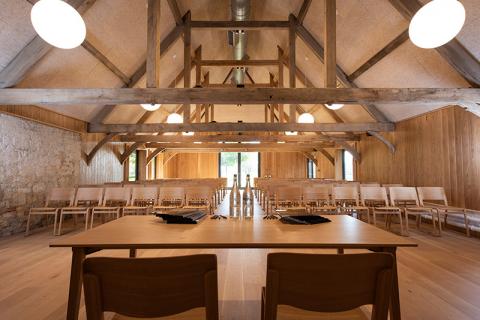
The Research Centre set up with tables and chairs in theatre layout

The Research Centre is governed by a sub-committee to the Academic Committee. The current Director is Professor Emanuela Tandello, who is supported by four senior members, all of whom are members of the Academic Committee, and an Administrator. Those eligible to apply are senior members of the college, who are members of the Governing Body, Senior and Junior Research Fellows, Emeritus Students, and some long-term college lecturers teaching for at least six hours per week.

As well as funding projects outside Christ Church the Research Centre itself can host conferences in the 19th Century Thatched Barn.

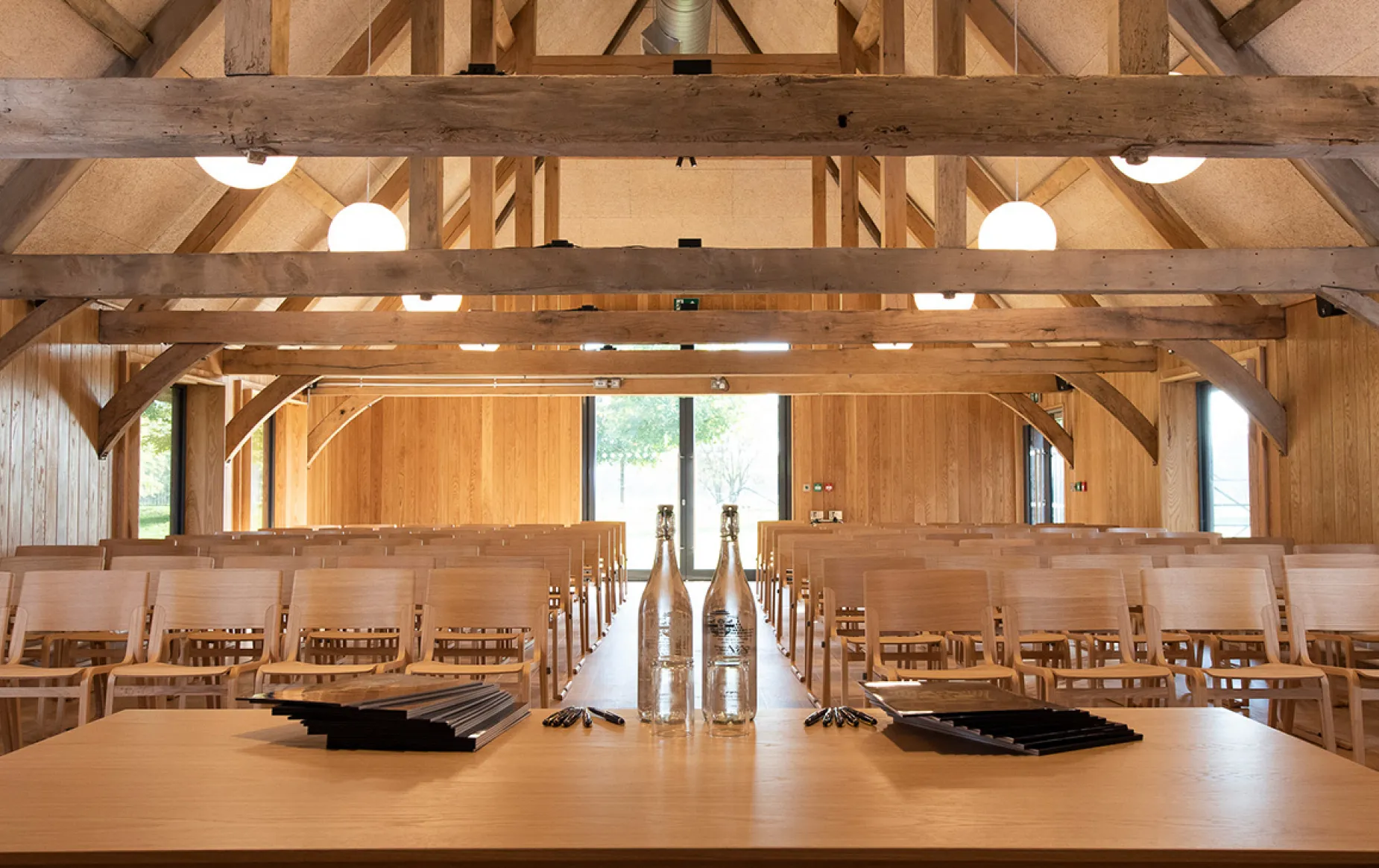
The modern accessible Research Centre boasts a spacious lecture room with exposed beams and views across Christ Church Meadows. It is an excellent conference venue, with advanced video conference equipment.

There is also the possibility of Conference Dinners and other meals to be taken in college, with other refreshments and light lunches can be taken in the adjoining fully equipped catering area in the Research Centre itself.

Most conferences and workshops culminate with a participants Dinner in the Great Hall. These dinners are also supported by the Research Centre.

The Research Centre set up with tables and chairs in one of several possible conference layouts

The capacity of the Research Centre is Theatre style 100; Class Room 45; Boardroom 50; U-Shape 44 and Cabaret 96.  It is a fully accessible area making it a suitable venue for many conferences and workshops.

Since 2017 the Research Centre has awarded over £800,000 on supporting conferences, hiring research assistants, purchasing computers and telescopes. 

 In addition to hosting conferences, workshops and book launches previous awards have included:-

  • the purchase of disc space on the already existing LOFAR-UK computing cluster to enable a postdoctoral research fellow to continue her research on galaxy evolution. 

  • The purchase of a high-performance computer to enable a junior research fellow to track male elephants to see how they respond to risk using GPS tracking data from up to 35 male elephants collected in northern Kenya between 2000-2020.

  • Supported several colleagues in funding the cost of a Research Assistant to help with the completion of projects.

Book Launches

The Research Centre has funded several book launches, often held in the Upper Library or the Picture Gallery.  A sample of these are Light on Darkness: The Untold Story of the Liturgy written by Cosima Clara Gillhammer, Plutarch Alexander translated with introduction and commentary by Christopher Pelling, A Gaping Wound: Mourning in Italian Poetry edited by Adele Bardazzi, Francesco Giusti and Emanuela Tandello, Reformation, Resistance, and Reason of State (1517-1625) written by Sarah Mortimer.

Seminars

There is an annual allowance available for members to host informal seminars.  Plans are being put in place to hold a series of ‘in-house’ interdisciplinary seminars which will involve the Graduate Members as well as Senior Members and Junior Research Fellows.   

Previously we have supported a talk and wine reception to the Computer Scientists by Sir Tim Berners Lee, a seminar and wine reception for Africa House and a seminar and wine reception for the Physicists.

A selection of recently published book covers

Abstracts of projects supported by the Research Centre

Exoticism, Colonialism and decadence around the fin de siècle

Professor Jennifer Yee, Lecturer in French, Official Student

Professor Yee arranged a conference on Exoticism, Colonialism and decadence around the fin de siècle, and publish a related volume, with the support of the Christ Church Research Centre.  The conference and related volume aimed to explore the intersections between ideas of decadence and the experience and discourses of colonialism, in French literature and culture, or between France and other literatures. ‘Decadence’ is a concept used more provocatively than prescriptively, primarily in the last decades of the nineteenth century, and it is usually understood in medical, historical or stylistic terms. The conference aimed to situate French metropolitan ‘decadence’, too often seen in an apolitical light, within the broader geographical, cultural and political context of colonialism. 

Leopardi Studies at Oxford

Professor Ela Tandello, Emeritus Student

‘Leopardi Studies at Oxford’ – acronym LEO – is dedicated to the study of the work Giacomo Leopardi (1798 – 1837), Italy’s major Nineteenth-century poet and thinker, and one of the major figures of European Romanticism.

The Research Centre has generously supported LEO events over the years, including the International Conference “Contaminazioni leopardiane”, which took place in September 2020, and two consecutive Leopardi Research Days, in June 2023 and 2024.

Past and present: narratives of progress and decline in nineteenth-century Britain

Dr Joshua Bennett, Junior Research Fellow in History

The Research Centre supported Dr Bennett’s work towards a conference on ‘Past and present: narratives of progress and decline in nineteenth-century Britain’.  He held a one-day interdisciplinary symposium which brought historians and literary scholars together to discuss the constitutive roles of ideas of ‘progress’ and ‘decline’ in nineteenth-century British culture. The conference explored how progressive and retrogressive understandings of historical movement percolated well beyond texts produced within the emergent discipline of History, to saturate a much broader sphere of social and cultural experience. The day’s discussions opened up new perspectives on how Victorians debated and represented historical time, in fields ranging from politics to the visual arts.

Dr Leah Morabito, Millard and Lee Alexander Postdoctoral Research Fellow

The Research Centre supported Dr Morabito’s project on Understanding How Super-Massive Black Holes Impact Galaxy Evolution.  The project focused on using radio data from the Low Frequency Array to study galaxy evolution. The data provided unique information on energetic phenomena associated with super-massive black holes which reside at the centres of massive galaxies. She has developed bespoke data reduction techniques to produce the highest resolution images at low radio frequencies, which is critical to answering the question: what physical process produces these energetic phenomena, and how do they impact galaxy evolution? Dr. Morabito used these techniques on several data sets for a comprehensive, state-of-the-art study of galaxy evolution. 

Dr Chihab el Khachab, Junior Research Fellow

This project investigated the efforts of civil servants in Egypt to create, promote, and shape new technological and cultural policies. This research described how people at the intersection of civil bureaucracy and private industry managed to keep the state's operations running over the past few years, and how the state implemented its strategy in practice. The outcome of the project will be the first systematic study of the state administration in Egypt since 1952, and engaged in wider debates about the ways in which state bureaucracy maintains its authority and implements its program under conditions of uncertainty

End of project reports

Dr Chihab El Khachab – Junior Research Fellow in Anthropology

In Hilary 2018, I convened a seminar series entitled “Current Trends in the Anthropology of Bureaucracy” under the auspices of the Christ Church Research Centre. The purpose of the seminar was to gather an international community of scholars conducting long-term ethnographic research on bureaucratic settings across the world, while highlighting their distinctive contributions to an area traditionally dominated by sociology and political science. 

Speakers at the seminar series included: Dr Eda Pepi (Yale), who discussed family registers and citizenship in Jordan; Dr Michael M. Prentice (Harvard), who discussed the corporate/bureaucratic interface in South Korea; Dr José-María Muñoz (Edinburgh), who talked about transport bureaucracies in Cameroon; Seamus Montgomery (Oxford), who talked about EU bureaucrats under the Juncker commission; Dr Bernardo Zacka (Cambridge), who discussed welfare service provision in the United States; Dr Julie Billaud (Sussex), who gave an account of the United Nations’ Universal Periodic Review (UPR); and Marie Alauzen (Mines ParisTech), who introduced us to the recent digitization and modernization efforts of French state administration. 

Since most of the papers presented were works-in-progress, they are still in the process of being published. For now, a detailed report on the seminar’s core questions and themes is available here: http://allegralaboratory.net/current-trends-in-the-anthropology-of-bureaucracy-a-report/ 

Dr Leah Morabito – Millard & Lee Alexander Fellow

My research focusses on using radio data from the Low Frequency Array (LOFAR) to study galaxy evolution. These data provide unique information on energetic phenomena associated with super-massive black holes which reside at the centres of massive galaxies. I have developed bespoke data reduction techniques to produce the highest resolution images at low radio frequencies, which is critical to answering the question: what physical process produces these energetic phenomena, and how do they impact galaxy evolution? I am using these techniques on several data sets from the Low Frequency Array (LOFAR) for a comprehensive, state-of-the-art study of galaxy evolution. However, the data reduction techniques require very fine time and frequency resolution in the data, which results in extremely large data volumes. The typical size of dataset I work with is about 20 TB, and the data reduction more than doubles this before producing the final science-ready images (which are much smaller). This intensive data processing requires working on large computing clusters, where disk space is limited. Over the past year, thanks to an award from the Christ Church Research Centre, I have been able to test new techniques to process data, working on three separate datasets (initially over 60TB of data!). This would not have been possible without the award of a 100 TB disk which was connected to the LOFAR-UK computing cluster.

Three publications based on this work were published in 2019.

Oxford Workshop of the Historical and Theological Lexicon of the Septuagint at Christ Church Research Centre, 2-6 July 2018, at the Centre for Hebrew and Jewish Studies

Summary

From 2 to 6 July, 18 scholars from 8 countries got together in the framework of the Historical and Theological Lexicon of the Septuagint project. Five papers were read, and small working groups revised or completed articles of the Lexicon. 

Scientific programme

Each day of the workshop there was a paper (see the attached programme) presenting new ideas and methodological hints. On Wednesday and Thursday, Dr J. Aitken of Cambridge University, who is on the advisory board of the HTLS, attended the morning lecture. The level of the lectures was excellent. Because only 5 papers were read we decided not to publish proceedings of the workshop. Otherwise, the programme consisted of group work on articles in various stages of preparation. The participants had access to internet courtesy of the Hebrew Centre and some of them got library cards so as to be able to access the resources of the Bodleian. Almost all the participants had earlier experience in preparing articles for the Lexicon which made the work very productive.