
Internet of Birds project wins ARIA funding
Christ Church biologist Dr Tonya Lander has won government funding to develop solar-powered tracking rings that could turn birds into a global network of environmental sensors, gathering data on biodiversity, climate change and disease on a scale that conventional wildlife-tracking technology cannot match.
Dr Lander and Professor Chris Stevens of the University of Oxford’s Department of Engineering Science have been awarded seed funding of up to £500,000 from the Advanced Research + Invention Agency (ARIA) for The Internet of Birds, an ambitious project that aims to transform how scientists monitor wildlife and environmental change.
Part of ARIA’s Engineering Ecosystem Resilience opportunity space, the project will develop lightweight, low-cost, solar-powered bird leg-rings capable of providing continuous global tracking. Working with Tom Willcock of Baltoro, the team hopes to harness birds as mobile environmental sensing platforms, generating information that could transform research into biodiversity and ecosystem resilience.
The researchers plan to create miniature tracking leg-rings that can be fitted to birds and connected through existing telecommunications infrastructure. Powered by solar energy and designed to be lightweight and inexpensive, the devices could enable data collection on a scale that is currently impossible with conventional wildlife-tracking technologies.
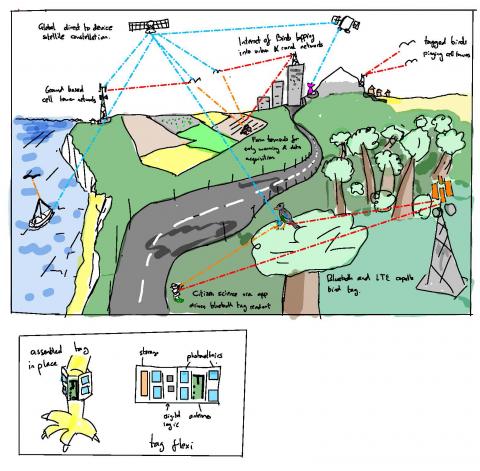
Birds play a vital role in ecosystems through pollination, seed dispersal and nutrient cycling. They are also important indicators of environmental health, providing insights into climate change, pollution, water quality and biodiversity. By overcoming the limitations of existing tracking technologies – including tag size, battery life, cost and geographical coverage – the project aims to generate unprecedented datasets on bird movements and environmental conditions.
We expect this technology to drive a sea-change in our understanding of bird ecology and conservation needs.
We expect this technology to drive a sea-change in our understanding of bird ecology and conservation needs.
The information gathered could support species conservation, environmental impact mitigation, zoonotic disease modelling, and wider efforts to halt biodiversity loss and protect ecosystem functions.
Dr Lander said: ‘The British Bird Ringing Scheme began in 1909, and birds have been tracked using a range of methods ever since. Since 2012, however, advances in digital data storage, internet technology and internet security have created an opportunity for a new generation of bird trackers. These devices could be small, light and inexpensive enough to replace traditional rings while providing regular global location updates throughout a bird’s lifetime.
‘We expect this technology to drive a sea-change in our understanding of bird ecology and conservation needs, enable targeted interventions to protect birds and human energy infrastructure, and improve strategies for preventing and mitigating bird-borne zoonotic diseases.’
Dr Lander’s research focuses on pollinator ecology and the development of innovative animal-tracking technologies, while Professor Stevens specialises in sensing, radar and imaging systems. Their latest project builds on earlier work tracking individual insects and forms part of BioTracks, a proposed Oxford spin-out developing advanced technologies for monitoring wildlife movements. Together, the team brings expertise spanning biology, ecology and engineering to address some of the most pressing environmental challenges facing the natural world.
Commenting on the award, Dr Lander said: ‘ARIA supports high-risk, high-reward research with the potential to make substantial contributions to solving real-world problems. We’re absolutely delighted that they have recognised the potential of our work and chosen to support this project. It’s going to be an exciting few years!’
Commenting on the technological challenge behind the project, Professor Stevens said: ‘If you want to build a mobile phone for a bird, it needs to be extremely small, completely self-powered, and capable of operating for years without attention. Birds cannot be relied upon to charge their phones, and they have no pockets, so we decided to follow the familiar leg-ring format.
‘You might wonder why a Professor of Engineering is interested in a bird-tracking project. The challenge is to pack the key functions of a mobile phone into a device not much bigger than the last joint of your little finger, while requiring no charging and operating reliably for years. As engineers, we enjoy solving difficult problems – and this is a fascinating challenge with the potential to deliver real benefits for conservation and environmental research.’
The Internet of Birds is funded by the Advanced Research + Invention Agency (ARIA) within its Engineering Ecosystem Resilience opportunity space.
In this film, Dr Lander explains what undergraduate students of Biology can expect at Christ Church.
Other Christ Church news