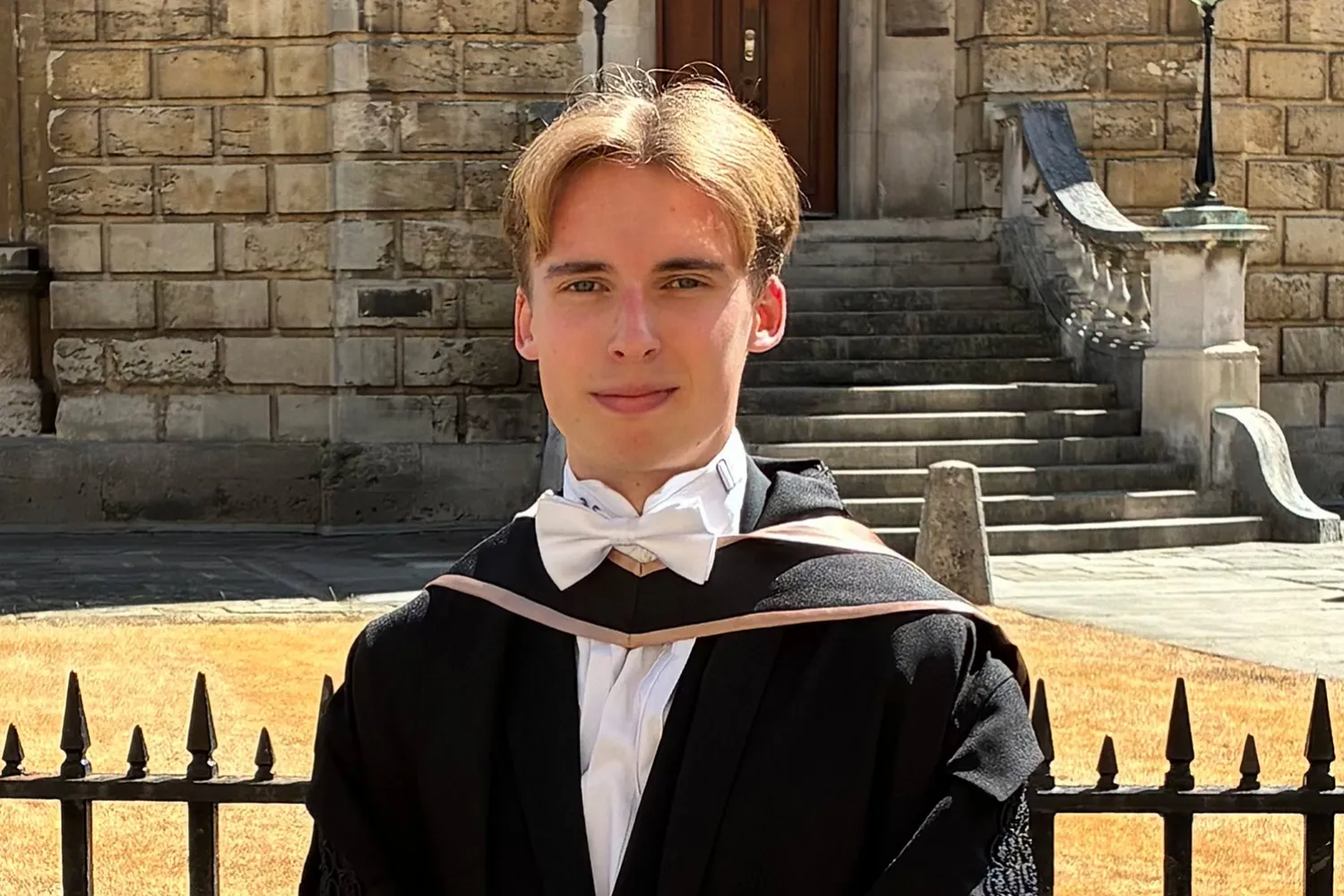

Lucas Colley awarded prize for outstanding performance in Computer Science and Philosophy
Christ Church graduate Lucas Colley has been awarded the Hoare Prize for the best overall performance in the Final Honour School of Computer Science and Philosophy. The award recognises an undergraduate career that combined academic excellence with internationally recognised contributions to open-source scientific software.
The Hoare Prize is awarded annually by the University of Oxford’s Department of Computer Science to the student achieving the highest overall performance in Computer Science & Philosophy. Lucas received the 2026 prize following his final examinations, marking the culmination of four years of achievement both within and beyond the classroom.
Christ Church has previously featured Lucas for his work on SciPy, one of the world’s leading open-source scientific computing libraries. Since first contributing through a Christ Church Summer Bursary project, he has become a maintainer of the project and continued to develop software used by researchers around the world.
In his final year, Lucas balanced two Philosophy papers – Theory of Politics and The Ethics of Artificial Intelligence and Digital Technology – with a Computer Science research project, Batched and Hardware-Accelerated Iterative Sparse Linear Solvers in Python. He notes 'I found many of the topics in these two Philosophy modules engaging, but I especially enjoyed being able to choose topics for extended research essays. I wrote an essay on the future of ‘meaningful’ work in a world of developing AI, and an essay on the link between the political notion of ‘freedom’ and an understanding of social context as a constitutive element of the self. I think both of these topics are valuable areas of research with potentially important implications for politics, in the present and in the future.'
Alongside his academic work, Lucas continued maintaining open-source software projects including SciPy and Pixi, with a focus on maintaining core tools for the scientific Python community and making it easier for others to contribute. Following his examinations, he travelled to Kraków to deliver talks at both the EuroPython and EuroSciPy conferences, with support from the Christ Church Summer Bursary.
I’m pleased to have proved to myself that I could achieve something which I thought was unachievable.
I’m pleased to have proved to myself that I could achieve something which I thought was unachievable.
Receiving the Hoare Prize came as an unexpected honour: ‘The prize certainly came as a surprise, but I was very happy to have a kind of formal recognition that my hard work had paid off.
‘It means a lot given that I didn’t think I would even get into Oxford when I was applying, never mind graduate with a first-class degree. I’m pleased to have proved to myself that I could achieve something which I thought was unachievable.’
Lucas also paid tribute to those who supported him throughout his studies: ‘I’m thankful to my tutors, who provided very valuable direction and feedback on my coursework submissions this year, and to my friends and family, whose support has been essential over the past few years.’
Reflecting on his time at Christ Church, Lucas said the breadth of the Computer Science & Philosophy course had allowed him to develop interests he had not expected to pursue: ‘I’m grateful for how diverse and engaging I found the Computer Science and Philosophy degree programme, especially for the flexibility and range of choice available for specialisation in the final year. 'I was able to spend a lot of time pursuing some of the topics I found most interesting as part of my academic requirements, while also keeping time for lots of extra-curricular work in open-source software.’
'He added that he found Christ Church to provide not only a great environment in which to study, but also one in which to switch off from academic work, with a consistent highlight of the year being playing for the College's men's football club as its co-president.'
Lucas now hopes to begin a career in software engineering while remaining closely involved with open-source software for the scientific community. Looking further ahead, he also hopes to continue exploring the kind of political philosophy questions that captured his interest during his degree.
Other Christ Church news