
Responding to AI: artists explore creativity in the age of artificial intelligence
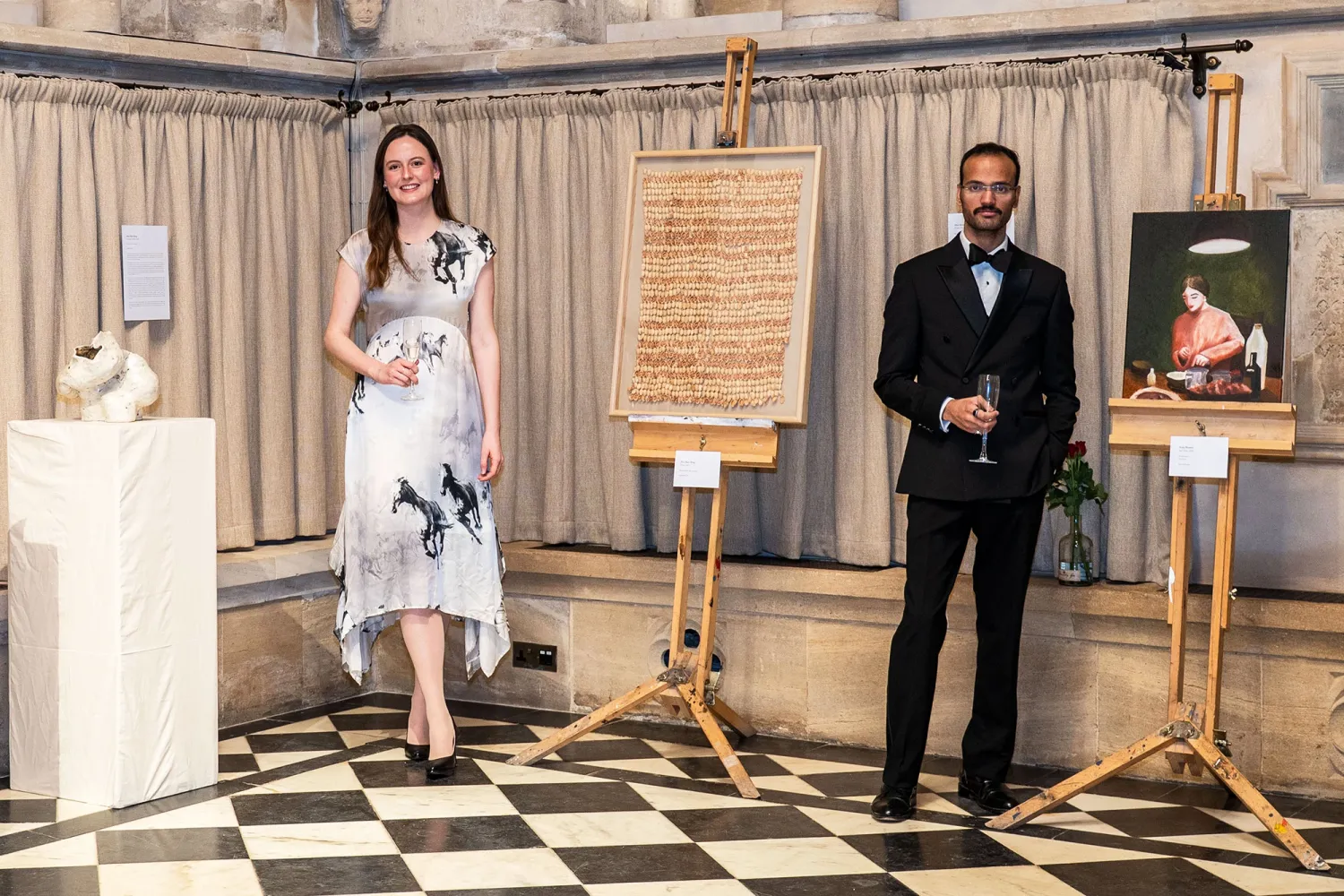
Last month, an exhibition curated by Christ Church doctoral student Aniq Shamsi and artist Alice King brought together student and professional artists to reflect on art, technology, and what it means to create in the age of artificial intelligence.
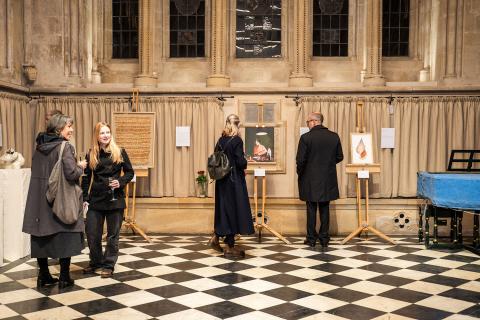
Responding to AI, held on 7–9 February at Christ Church, featured work by artists currently studying at the University of Oxford alongside pieces by UK-based artists. The exhibition explored artists’ perceptions of artificial intelligence and asked what it means to be human in an era increasingly shaped by rapidly developing technologies.
The exhibition was curated by Aniq Shamsi, a DPhil finalist in Engineering Science at Christ Church, in collaboration with Alice King, an Oxford-based artist and educator. Shamsi’s academic research sits at the intersection of network science, machine learning and causality, focusing on temporal graph learning and its counterfactual evaluation through causal models.
Alongside his doctoral research, Shamsi has developed an active artistic practice. During his DPhil he returned to drawing and painting, carrying a sketchbook while travelling and documenting places he visited as part of the international Urban Sketchers movement. He later became a regular participant in the Christ Church Art Room, an initiative led by Dr Sarah Simblet, where he began working with oil paints.
‘Given the widespread use of AI – to the point where people now question whether everything is AI-generated – we thought it was the perfect time to gauge the interest of artists and the general public in the topic, and to let them respond to AI,’ Shamsi said.
The idea for the exhibition emerged through conversations with Alice King, whom Shamsi met through his Instagram account showcasing his sketches. Together they invited artists to reflect on the technological, creative, and philosophical questions raised by AI’s rapid development.
The resulting exhibition brought together a wide range of responses to the theme. Artist David Weller reflected on the diversity of perspectives on display: ‘This exhibition shows the talents of the artists involved – a wide range of interpretations of the title “Responding to AI”. Fine art has become intertwined with AI, perhaps even in a way that shows a battle that could push them apart. I see AI as a future that will touch every part of our lives.’
Several artists focused on the contrast between human artistic labour and the speed of machine-generated imagery. Daisy Johnston described the painstaking reality of painting: ‘With my piece, I wanted to show the reality behind making art – late nights agonising over small details perched inches from the canvas, trying to figure out if what you just changed has actually made things any better whilst AI quickly fills the niche.’
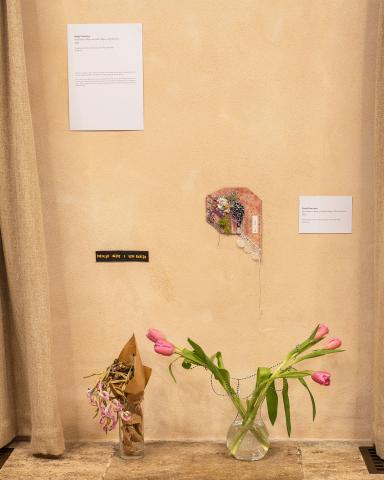
For M. Freddy, the response to AI took the form of a personal and reflective work combining text and drawing. ‘I responded to AI with a personal letter and a drawing of the wildflowers my Airedale terrier discovered,’ he explained. The work formed part of Correspondence Club by M. Freddy, a subscription-based series inspired in part by their time as a Global Diplomacy Fellow at the United Nations.
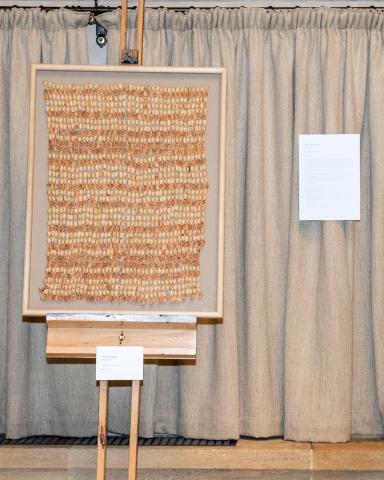
Other artists explored the importance of handmade artistic processes. Ruth Swain praised the exhibition’s range of approaches: ‘A fantastic concept for an exhibition and beautifully curated. The variety of work – particularly the pistachio shell piece and the family tree in ancient cuneiform – showed hand-crafted pieces rather than slick AI creations.’ Swain’s own painting responded directly to the theme, depicting a book about AI and a reader in an image created entirely by hand.
Another perspective came from Alan Kestner, whose work Dark Eyed Sailor explored the role of AI as a creative assistant rather than a replacement for human creativity. Drawing on a familiar cultural metaphor, he compared the technology to the magical apprentice in Disney’s Fantasia: ‘AI is enormously helpful if it is the apprentice, not the sorcerer. Chaos follows if you allow it – like Mickey Mouse – to cast the spells. AI helped with my image’s donkeywork, but it didn’t notice the text became indecipherable when it was wrapped into a cone.’
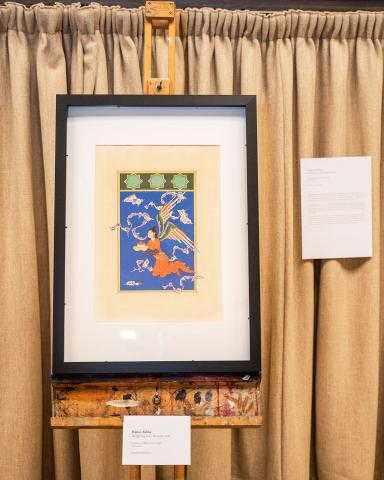
Kestner also highlighted the work of fellow artist Farrah Azam, whose intricate visual language particularly stood out to him. ‘I really like the simple but delicate and intricate marks Farrah makes,’ he said. ‘They have the character of decorative ornamentation and remind me of calligraphy and the beautiful tiles in a mosque. But when combined together, all the marks build into an imaginative whole – the image of an Islamic building.’
The exhibition attracted strong interest from visitors and sparked lively discussions about the relationship between human creativity and machine-generated imagery. It also received attention beyond the College: a review in the student newspaper Cherwell praised the exhibition’s thoughtful engagement with the subject and its exploration of how artists are confronting the future of art. Readers can find the review, ‘Confronting the future of art: “Responding to AI” at Christ Church’, on the Cherwell website.
Through a wide range of artistic approaches, Responding to AI invited viewers to reflect on how artists are engaging with one of the defining technologies of the present moment – not only as a tool, but as a subject of creative inquiry.
Other Christ Church news