Novel research demonstrates the power of AI to transform cancer care
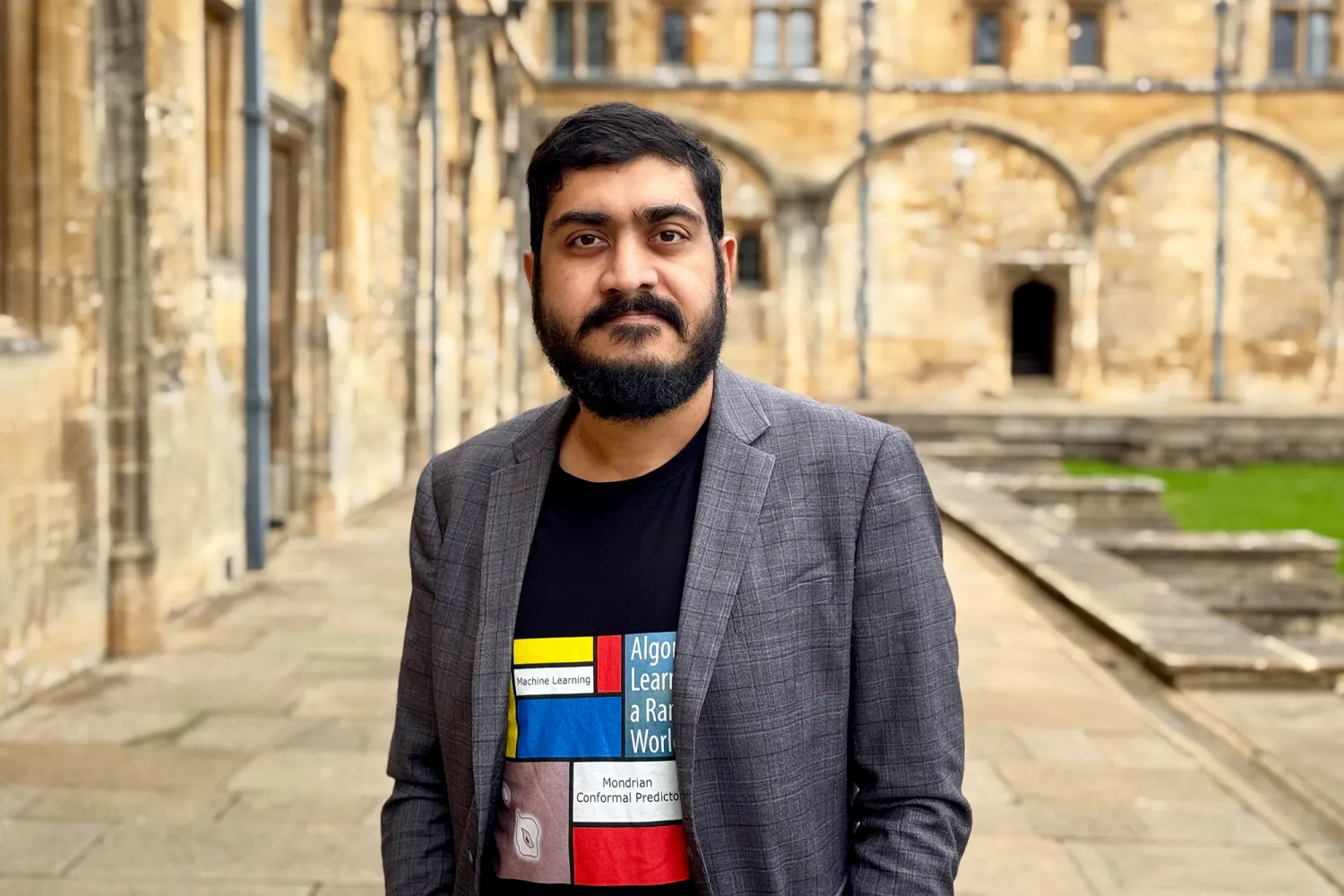
Groundbreaking findings from an interdisciplinary team of researchers led by Dr Tapabrata Rohan Chakraborty, Lecturer in Computer Science at Christ Church, have been published in the leading journal Nature Communications. The study demonstrates how artificial intelligence can improve the accuracy and usefulness of cancer predictions by generating synthetic molecular data from routine pathology images.
AI has enormous potential to improve cancer care, particularly when different types of data are combined, such as histopathology images (microscope images of tissue samples) and genomic information. However, tests that measure gene activity – known as ‘transcriptomic assays’ – are expensive, time-consuming, and not routinely carried out for every patient. By contrast, digital pathology slides are a standard part of cancer diagnosis worldwide.
To bridge this gap, Dr Chakraborty’s international team developed a novel AI model called ‘PathGen’. PathGen is a crossmodal generative model, meaning it can learn relationships between different types of data. Using advanced generative AI techniques, it is able to synthesise transcriptomic information directly from routine cancer histopathology images. When this synthetic molecular data is added to multimodal prediction models, which combine more than one type of data, performance improves significantly compared to using image data alone. Improvements were seen in both cancer grading and patient survival estimation.
This has huge potential for improving cancer care at scale.
This has huge potential for improving cancer care at scale.
The research was evaluated using several large public cancer data sets, covering brain, kidney, uterine, and breast cancers. For all of these cancers, and across different patient demographic groups, the model demonstrated consistent gains in predictive accuracy and reliability.
Commenting on the significance of the findings, Dr Chakraborty said: ‘This is an example of the positive use of frontier AI for the benefit of humanity. By showing that AI-based generation of genomic signatures from cancer tissue images improves predictions across cancer types and patient demographics, this has huge potential for improving cancer care at scale.’
Dr Chakraborty also highlighted the collaborative context of the work: ‘This project exemplifies a successful UK–India research partnership under the UK–India Vision 2035. It was carried out jointly with the Alan Turing Institute, the UK’s national institute for AI, and the Indian Association for the Cultivation of Science, India’s oldest national research institute.’
Looking ahead, the team is expanding the model’s capabilities to generate spatial transcriptomics – more detailed maps showing where gene activity occurs within tissue samples – and to integrate generative AI methods for automated medical reporting from multimodal cancer datasets. Dr Chakraborty will present the research at the AI Impact Summit in India in February 2026 on behalf of the UK–India AI Centre.
Funding for the main project comes from the Alan Turing Institute through the Turing–Roche Strategic Partnership. In addition, Dr Chakraborty has recently been awarded a two-year grant from the Christ Church Research Centre to study ‘uncertainty quantification of frontier AI’. This work will feed back into the main project by improving the reliability and trustworthiness of AI models such as PathGen.
Dr Chakraborty is a Lecturer in Computer Science at Christ Church, University of Oxford, and a Theme Lead in Frontier AI Assurance at the Alan Turing Institute. Learn about his research via his Christ Church profile.
Other Christ Church news