
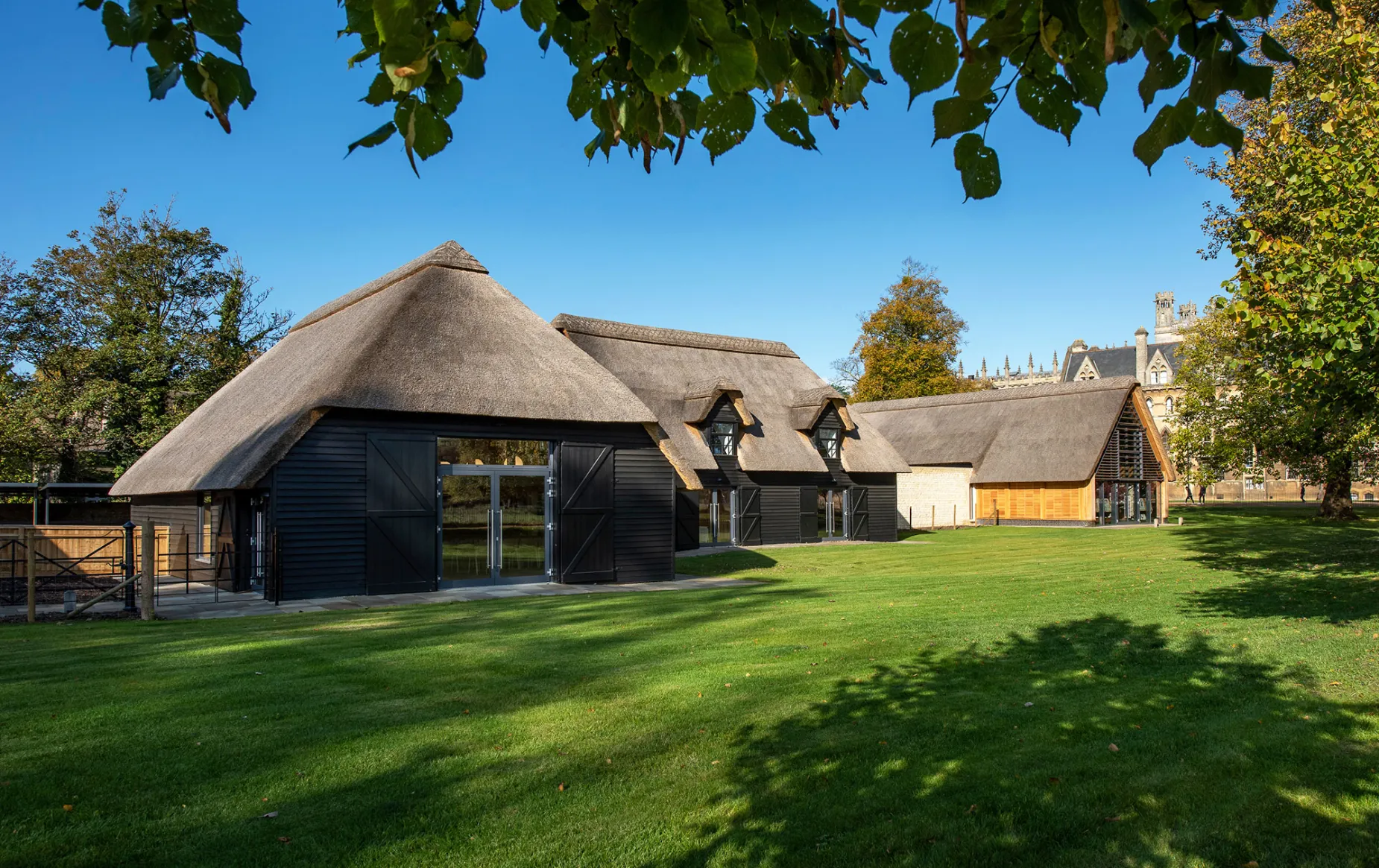
Junior Research Fellowships

Junior Research Fellowships are full-time positions for early-career researchers who are nearing completion of, or who have recently been awarded, their doctorate.

The fellowships offer an unrivalled opportunity to spend three years developing an independent research profile within a vibrant collegiate community, with the possibility of a fourth year to complete a major project.

We typically advertise four positions each year across a broad range of disciplines.

Below, you can hear from some of our recent JRFs about their experience.

Christ Church JRFs

Dr Miriam Rothenberg

Miriam is an archaeologist whose work explores how past and present communities respond to volcanic eruptions. Hear about her time as a Christ Church JRF. 

Christ Church JRFs

Dr Emily Brady

Emily is now a Departmental Lecturer in American History at Pembroke College, Oxford. During her time as a Christ Church JRF, she investigated the role of Black women photographers in the Civil Rights Movement.

Recent research

The covers of some recently published books
Books

Recently published books

View the latest books authored and edited by members of the Christ Church community.

See details of recently published books

Featured video
Professor Jonathan Cross

Featured video
Dr Tonya Lander

Lichens under a magnifying glass
Appreciating our living stone

How lichens are bringing stone to life and reconnecting us with the natural world

In this article – a runner up in The Conversation Prize for writers  – Christ Church Lecturer in Physical Geography Dr Nicholas Carter explores how attending to lichens can enable us to value the crucial role of stone in the natural world and make us better stewards of the environment.

Read the article in The Conversation

What our DPhil students do

Christ Church offers a wide range of graduate courses. See below for a taste of our DPhil candidates’ diverse research topics and click here to learn more about graduate study at Christ Church

LEMUEL

“In the UK roughly 80% of wasted energy is in the form of heat. Direct waste heat-to-electricity energy conversion represents a promising route to making our electricity base more sustainable. Waste heat from homes, automotive exhausts and industrial processes could be converted into electricity using thermoelectric generators – silent and dependable, solid-state devices that don’t rely on chemical reactions or produce toxic by-products.

“My project offers a special opportunity to join groups in two different Oxford departments (Chemistry and Physics). The hope is that novel solid-state compounds will be discovered, measured and controlled chemically with the aim of understanding the relationships between the composition, structure and thermoelectric performance.”

Lemuel, a DPhil candidate
AMANDA

“I'm researching how playing video games might influence the ways we think, know, and make meaning. As games become more widespread and integrated into people's daily lives, it's important to understand how they shape our relationships with knowledge. I take an ethnographic case study approach to do this, involving in-game interviews, diary studies, and semi-structured ethnographic interviews.

“My research builds off a pilot study I ran last year, where I interviewed players of ‘Animal Crossing: New Horizons’ inside of the game itself. I explored how players use the game to reflect on their identities, express themselves creatively, connect with their friends and loved ones, and think critically about their own lives. In addition to examining player experiences, I’ll be interviewing game designers to understand their intentionality into such meaning-making experiences through play. I plan to develop design guidelines to consider what the future of everyday play can and should look like.”

Amanda, a DPhil candidate
KERRY-ANNE

“Temperatures in Southern Africa are rising at twice the global rate and the prevalence of hot temperature extremes, coupled with extended periods of drought, is increasing. Having contributed to the recent Intergovernmental Panel on Climate Change’s (IPCC) Sixth Assessment Report highlighting the impacts of climate change on ecosystems globally, I was made aware of the lack of understanding of how climate extremes are affecting the unique systems of the Southern Hemisphere. As a South African and former climate change researcher at the University of Stellenbosch, this question greatly concerns me. 

"I’ll be compiling a first-of-its-kind dataset for Southern African savannas on the physiological response of dominant tree species to a range of temperatures, including extended heatwaves, under varying levels of water stress along a temperature and rainfall gradient in Southern Africa.”

Kerry-Anne